Effects of combined training on functional fitness and
blood pressure in older women
Efeitos do
treinamento combinado na aptidão funcional e pressão arterial em mulheres
idosas
Laíza Ellen Santana Santos1, Antonio
Gomes de Resende Neto2, Cleide Ane Barbosa da Cruz2,
Márcio Getirana-Mota2, Marzo Edir Da Silva-Grigoletto1
1Universidade
Federal de Sergipe, Aracaju, SE, Brazil
2Centro
Universitário Estácio de Sergipe, Aracaju, SE, Brazil
Received: April 12, 2025; Accepted:
July 8, 2025.
Correspondence: Laíza Ellen Santana Santos, laizaaellen@gmail.com
How to cite
Santos LES, Resende Neto AG, Cruz CAB, Getirana-Mota
M, Silva-Grigoletto MED. Effects of combined training on functional fitness
and blood pressure in older women. Rev Bras Fisiol Exerc 2025;24(1):e245628. doi: 10.33233/rbfex.v24i1.5628
Abstract
Objective: To
evaluate the effects of combined training (CT) on functional fitness and blood
pressure in older women. Methods:
Sixty-seven elderly women were randomized into two groups: CT (n = 35; 67.03 ±
4.41 years) and control (CG; n = 32; 67.69 ± 6.53 years). The intervention
lasted 12 weeks, with three weekly sessions of 50 minutes. The protocol
included warm-up with walking and squats, 32 minutes of resistance exercises on
machines, 12 minutes of walking/running and stretching. Functional fitness was
assessed by the following tests: shirt-on-shirt-off test
(SFT); 10-meter walk (C10m); time-up-and-go (TUG); standing-up from the floor
(SF); sitting-up from a chair – 5rep (SFC5r); gallon-jug
shelf-transfer (GJST); and 6-minute walk test (C6min). Blood
pressure (BP) was measured with a sphygmomanometer before and after CT. Results: At the end of the
intervention, CT showed statistically significant adaptations in all physical
abilities and BP in relation to the initial values. When compared to the CG, CT
promoted significant improvements in the C10m (∆%: 7.07; p
≤ 0.001); TUG (∆%: 9.62; p ≤ 0.001); C6min (∆%: 6.49; p
= 0.002); SF (∆%: 19.6; p ≤ 0.001); SFC5r (∆%: 10.3; p
≤ 0.001); SFT (∆%: 11.9; p ≤ 0.001); GJST (∆%: 9.6; p
≤ 0.001) and systolic blood pressure (∆%: 6.0; p ≤ 0.001). Conclusion: This protocol has been shown to be effective in reducing systolic
blood pressure and improving functional fitness in independent older women.
Keywords: cardiovascular
health; aging; resistance training; daily activities.
Resumo
Objetivo: Avaliar os efeitos do treinamento
combinado (TC) na aptidão funcional e pressão arterial de idosas. Métodos:
Sessenta e sete mulheres idosas foram randomizadas em dois grupos: TC (n = 35;
67,03 ± 4,41 anos) e controle (GC; n = 32; 67,69 ± 6,53 anos). A intervenção
teve duração de 12 semanas, com três sessões semanais de 50 minutos. O
protocolo envolveu aquecimento com caminhada e agachamentos, 32 minutos de
exercícios resistidos em máquinas, 12 minutos de caminhada/corrida e
alongamentos. A aptidão funcional foi avaliada pelos testes: teste vestir e
tirar a camisa (VTC); caminhada de 10 metros (C10m); time up and go (TUG); levantar do solo (LS); sentar
e levantar da cadeira (SL5r); transferência de galões (GJST) e teste de
caminhada em 6 min (C6min). A pressão arterial (PA) foi medida com
esfigmomanômetro antes e após TC. Resultados: Ao final da intervenção, o
TC apresentou adaptações estatisticamente significativas em todas as
habilidades físicas e na PA com relação aos valores iniciais. Quando comparado
ao GC, o TC promoveu melhoras significativas nos testes de C10m (∆%:
7,07; p ≤ 0,001); TUG (∆%: 9,62; p ≤ 0,001); C6min (∆%:
6,49; p = 0,002); LS (∆%: 19,6; p ≤ 0,001); SL5r (∆%: 10,3; p
≤ 0,001); VTC (∆%: 11,9; p ≤ 0,001); GJST (∆%: 9,6; p
≤ 0,001) e na Pressão arterial sistólica (∆%: 6,0; p ≤
0,001). Conclusão: O
presente protocolo demostra-se eficaz na atenuação da pressão arterial
sistólica e na melhora da aptidão funcional em idosas independentes.
Palavras-chave: saúde cardiovascular; envelhecimento;
treinamento resistido; atividades diárias.
Introduction
A progressive decline in cardiorespiratory and
musculoskeletal system function accompanies the aging process, leading to a
reduction in functional fitness and an increased prevalence of chronic
diseases, including systemic arterial hypertension (SAH) [1], which affects
over 60% of older adults [2].
From this perspective, the literature indicates an
association between chronic diseases and the inability to perform daily
activities in older adults [3]. Furthermore, regular physical exercise can
preserve or even improve functional fitness and cardiovascular health, thereby
delaying the onset of aging-related limitations [4].
There is a consistent
body of evidence regarding the hypotensive effect of acute [5,6] and chronic
interventions involving aerobic training (AT) and resistance training (RT)
individually [7,8]. A recent meta-analysis shows that AT reduces systolic blood
pressure (SBP) by 7.79 mmHg and diastolic blood pressure (DBP) by 5.97 mmHg,
while RT reduces SBP by 5.62 mmHg and DBP by 1.87 mmHg, respectively [9].
In this context,
combined training (CT) is a physical training method that can mitigate
functional declines associated with senescence. This approach integrates
neuromuscular and cardiorespiratory exercises within the same session [10], and
its effects on body composition [11] and physical fitness in older adults have
already been proven [12]. However, its potential as an antihypertensive therapy
remains unclear. Therefore, the present study aimed to analyze the effects of
CT on functional fitness and blood pressure in independent older women. We
hypothesized that integrated exercise protocols are efficient in promoting
multisystem adaptations in older adults.
Methods
The current study comprised a 16-week randomized controlled trial, with
12 weeks dedicated to the application of the intervention (TC), two weeks
allocated for data collection, and two weeks for familiarization. As such, the
present proposal adheres to the CONSORT recommendations (http://www.consort-statement.org).
Additionally, some hypotheses related to this topic were published prior to the
initiation of this project [13,14].
Furthermore, to ensure the rights (autonomy, non-maleficence,
beneficence, justice, and equity) of all research participants and to fulfill
the bioethical responsibilities advocated by the World Medical Association
through the Declaration of Helsinki (1964) and by the National Health Council
in Resolution No. 466/2012, the study was submitted to the Research Ethics
Committee involving Human Beings (CEP/CONEP). It underwent evaluation and
adaptation to current regulations and was subsequently approved by the Federal
University of Sergipe's Ethics Committee (Opinion No.: 3.225.938). The study
was registered with the Brazilian Registry of Clinical Trials (ReBEC) under protocol RBR-2d56bt.
Sampling procedures
To apply the protocol and for subsequent analysis,
older women who met the following intervention criteria were selected: (1) Age
between 60 and 80 years; (2) Not engaged in physical training programs within
three months prior to the study's commencement; (3) Ability to move
independently without support; (4) Cognitive status score ≥14 on the
Mini-Mental State Examination [15]; (5) Possession of medical clearance.
Participants with the following characteristics were not included in the study:
(1) Stage 2 hypertension (systolic ≥160 mmHg and diastolic ≥100
mmHg); (2) Any degenerative joint disease or joint implants; (3) Cardiovascular
and/or pulmonary disease that precluded high-intensity exercise; (4)
Neurological deterioration. Furthermore, participants who missed any
intervention stage or who completed less than 85% of the training sessions were
excluded from the analyses.
One hundred and sixteen independent older women
expressed interest in participating in the study. Of these, 36 were excluded
for not meeting the inclusion criteria, and 13 did not complete all
intervention stages (Figure 1). Consequently, 67 participants were allocated by
stratified block randomization, with participants equally distributed based on
lower limb strength into two distinct groups: (CT: n = 35; 67.03 ± 4.41 years; 27.58 ± 3.98 kg/m2) and (CG: n = 32; 67.69
± 6.53 years; 28.58 ± 4.54 kg/m2).
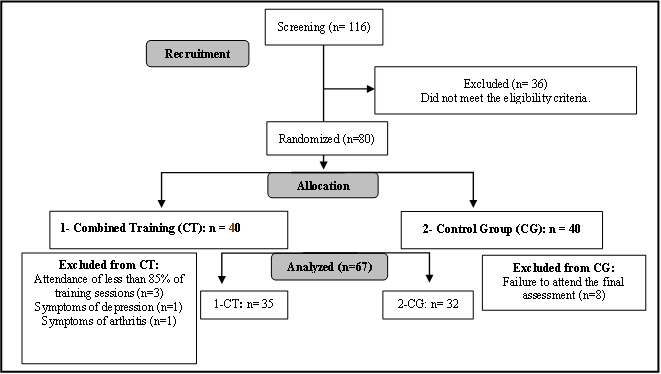
Figure 1 - Schematic representation of the study
screening, allocation and intervention processes
Physical
training program
All sessions were
conducted at a consistent time for all volunteers to ensure homogeneity and
minimize biases that could influence blood pressure analysis. There were 36
training sessions in total, comprising 3 sessions per week, each lasting 50
minutes, with a minimum recovery period of 48 hours between sessions.
Following initial
assessments, participants in the CT group underwent two weeks of
familiarization, during which they performed exercises at 50% of the intensity
planned for the first session. After this period, they engaged in supervised,
individualized, and progressive training. Progression was achieved through
daily quantification and multiplication of the lifted weight and volume (Volume
load = sets x repetitions x load) for the eight exercises in the neuromuscular
block [16].
Combined training
The protocol was structured within a single training
session, comprising four distinct exercise blocks. Block (1) consisted of a
general and specific warm-up. Block (2) involved circuit-based resistance
training using machines, targeting major muscle groups. Block (3) focused on
endurance training through interval running, and block (4) incorporated
submaximal stretching for the main muscle groups [14]. Table I provides a
detailed description of the training protocol.
Table I – Detailed description of the combined training protocol
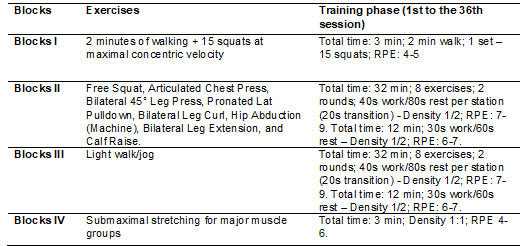
Min = minutes; s = seconds; RPE = Rating of Perceived Exertion.
In Block II, intensity was controlled using a
submaximal repetition range (8 to 12 reps). The criterion for terminating a set
was a reduction in concentric movement velocity exceeding three seconds. If
participants completed more repetitions than prescribed, the weight was
increased by 5-10% to maintain the predetermined repetition range. Similarly,
if the desired repetition range was not achieved, the weight was reduced.
The Control Group (CG) was instructed to
maintain their usual activities. To help retain participants throughout the
intervention, lectures on senior health and rights were offered every 15 days
over the 12-week intervention period.
Data collection procedures
Functional
fitness was assessed using specific tests designed to analyze performance in
essential skills such as walking, rising from a chair, and dexterity. These
skills are crucial for maintaining independence and overall quality of life. A
detailed description of all tests follows:
10-Meter Walk Test (C10m)
Maximal walking
speed was assessed using the 10-meter walk test (C10m). The volunteer was
instructed to walk a 12.4-meter course without any assistance, in the shortest
time possible [17]. Four cones and a tape measure were used to mark a straight
12.4-meter path on the floor. The volunteer walked 1.2 meters for acceleration,
10 meters for time recording, and 1.2 meters for deceleration. Two trials were
performed with a two-minute rest interval between them. The test was
invalidated if the volunteer exhibited a flight phase, characterizing a run
[18].
Timed Up and Go (TUG)
Lower-limb functional
fitness, emphasizing mobility, speed, agility, and dynamic balance, was
assessed using the Timed Up and Go (TUG) test. The test involved measuring the
time taken to complete a 3-meter walk with a change in direction. Volunteers
were instructed to sit in a chair with their back against the rest, arms at
their sides, and feet parallel. Upon the verbal command "go" from the
evaluator, they stood up, walked the 3-meter distance at a rapid, safe, and
comfortable pace, turned around, and sat back down. Three attempts were
performed, with a one-minute rest interval between each. The average of the
obtained results was used for final analysis. Any attempt was invalidated if
the volunteer made contact with the cone during the course. Additionally, the
TUG test demonstrates good reliability with an ICC of 0.99 [19].
Six-Minute
Walk Test (C6min)
Cardiorespiratory
capacity was assessed by measuring the distance covered while walking as fast
as possible for six minutes. The protocol utilized a marked 40-meter linear
course with sub-markings every five meters to facilitate accurate distance
measurement. Upon the evaluator's command ("go"), the volunteer began
the test, walking at a rapid and consistent pace (but not running) in a
straight line to the 40-meter mark. They then rounded the mark and returned to
the starting point, repeating this circuit until the six-minute timed duration
of the test was completed. This test demonstrates good reliability with an ICC
of 0.99 [20].
Standing-up from the floor (SF)
For global
functionality, the SF test was used, in which the volunteer was instructed to
lie in a prone position, with her arms parallel to her torso and her palms
facing upwards, and her face against the ground on her preferred side. On the
evaluator's command (“now”), the volunteer stood up in her usual way and tried
to stay in a balanced position, with her feet parallel and pointing forward,
and without moving, in the shortest time possible. A mat was used for support,
and a stopwatch was used to mark the time [21].
Sitting-up from a chair – 5r (SFC5r)
Lower limb
functional fitness, focusing on muscle strength and power in a functional
action, was assessed using the SFC5r test. The volunteer stood up from the
chair and returned to the starting position five times, as quickly as possible,
after the evaluator's command (“now”). Three attempts were made with an
interval of 1 minute. The measure was invalidated when the participant did not
touch the seat or remove her arms from her torso. It also has a good ICC
reliability of 0.95 and a minimum detectable difference of 2.5s [22].
Shirt-on-shirt-off test (SFT)
The SFT test was
used to assess upper limb coordination. The participant was asked to stand with
her arms parallel to her torso, holding a T-shirt in her dominant hand. When
the assessor gave the command (“now”), she had to put the shirt on completely
and then take it off, removing it if necessary, and holding it again with her
dominant hand, returning to the starting position in the shortest possible time.
Furthermore, the test has an ICC of 0.75, showing good reliability [21].
Gallon-jug shelf-transfer (GJST)
The GJST was
used to assess functional fitness with an emphasis on the upper limbs, in an
everyday action of transferring gallons on a shelf. The volunteer was
instructed to stand to the side of a bookcase (2.13 x 1.06 m with adjustable
shelves) with one shelf positioned at patella height, another at shoulder
height, and five gallons (3.99 kg each) positioned on the bottom shelf next to
each other, where they transported the gallons from one shelf to the other in
the shortest time possible. The attempt was not validated if the participant
moved more than one gallon at a time or switched hands to perform the movement.
In addition, this test was reliable with an ICC of 0.97 [23].
Determinants of blood pressure
To assess blood pressure
parameters, all BP measurements were taken on the left arm, with the volunteers
sitting with their feet flat on the floor, in silence for 30 minutes and in a
rest room, air-conditioned to 25ºC, using a properly calibrated and appropriate
sphygmomanometer. A cuff selected after measuring the circumference of each
participant's arm (Sanny, São Paulo, Brazil) was used and placed at the
midpoint of the left arm.
The procedure was used to
obtain SBP, DBP and HR. The average of each volunteer's three assessments was
used in the final analysis.
Statistical procedures
Descriptive
analysis, including mean, standard deviation, and percentage delta, was used to
characterize all obtained variables. Sample size was calculated using G*Power
software (version 3.1.9.2) based on the main functional fitness variables from
results reported by Resende-Neto et al.
[14]. Anticipating an average 10% improvement in participant performance, a
power of 0.80 was considered for the analyses performed in the present study's
sample size calculation.
Normality
was confirmed by the Shapiro-Wilk test, and homogeneity by Levene's test. A 2x2
ANOVA with Bonferroni post-hoc analysis was conducted for all analyses. Data
were tabulated and analyzed using JAMOVI software, version 2.4, with a
significance level set at 5% (p ≤ 0.05). All tests were two-tailed, and the
effect size (ES) was calculated according to the methodological procedures [24].
Results
The combined training
(CT) protocol showed a 96% adherence rate among participants. In the CT group,
two participants were lost due to medical exemptions, and three were lost due
to attendance falling below 90%. Conversely, the control group (CG) experienced
eight losses because participants did not complete all study stages (Figure 1).
The average participation rate was 34.5 out of 36 total sessions, resulting in
a sample loss of 13 individuals. Anthropometric characteristics of both groups
are presented in Table II; no significant differences were observed in these
values.
Table II - Characteristics of
participants in the Combined Training (CT) and Control (CG) groups at baseline.
Values are presented as mean, standard deviation, and percentage
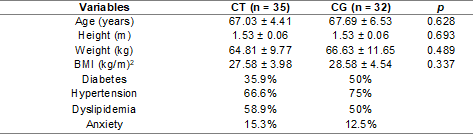
* BMI = Body mass index. % = Have the pathology.
Figure 2 shows that the total training load (Volume
load) was progressive throughout the training period.
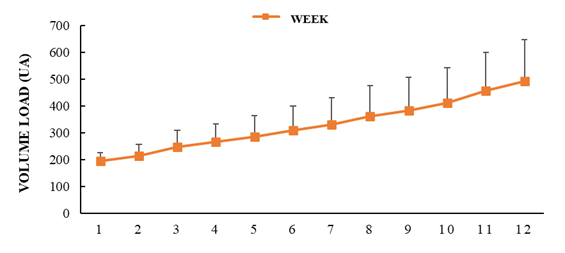
Figure 2 - Schematic representation of the behavior of
volume load over 12 weeks of combined training
At the end of the intervention, CT showed
statistically significant improvements in all the variables compared to the
initial values. When compared to the CG, CT promoted significant adaptations in
the following variables: 1) C10m (Δ%: 7.07; p ≤ 0.001); 2) TUG (Δ%: 9.62; p ≤ 0.001); 3) SF (Δ%: 19.6; p ≤ 0.001); 4) SFC5r (Δ%: 10.03; p ≤ 0.001); 5) SFT (Δ%: 11.9; p ≤ 0.001);
6) GJST (Δ%: 9.6; p ≤ 0.001). The detailed results of the interventions in
the tests applied are shown in Table II.
Table II - Effects of 12 weeks of combined training on
functional fitness and blood pressure in independent and untrained elderly
women
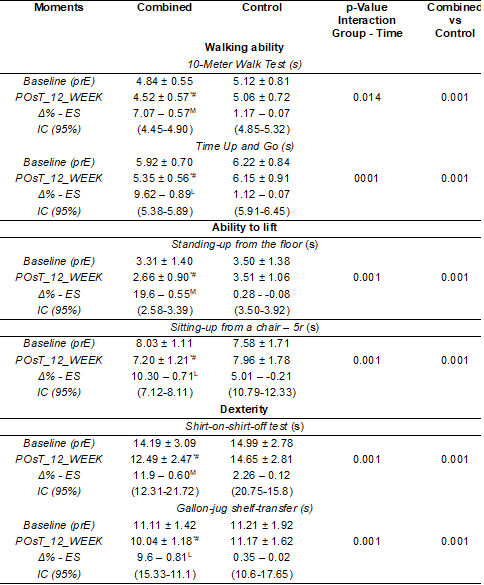
Values
presented as mean and standard deviation (M ± SD). s = seconds; * p ≤
0.05 vs. Baseline (pre). # p ≤ 0.05 vs. Control. Δ% = Percentage change between Baseline (pre) and
Post_12. ES = Effect size (SSmall: 0.2 -
0.4; MMedium: 0.5 - 0.7; LLarge: 0.8 - 1.33; VLVery
large: > 1.33). IC - Interval Confidence
About cardiorespiratory variables, HT led to
statistically significant improvements compared to CG in the 6-minute walk test
(C- Δ%: 6.49; p < 0.002); and in SBP (A - Δ%: 7.9; p ≤
0.001). However, no significant changes were observed in DBP (B- Δ%: 4.41;
p = 0.273) (Figure 3).
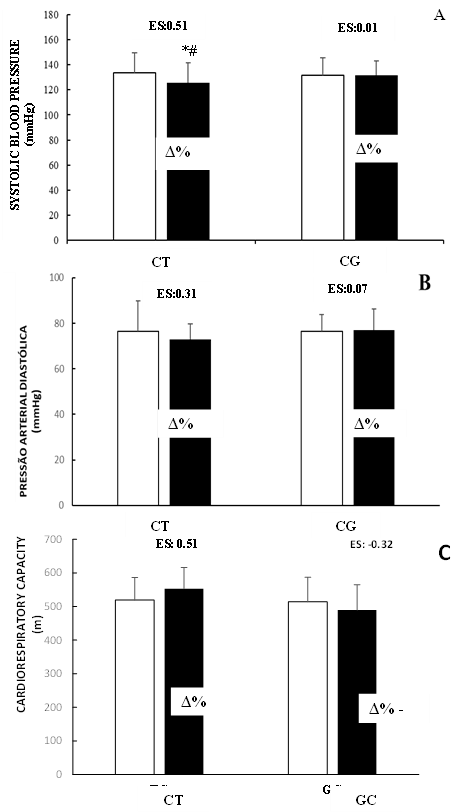
ES: Effect size. Δ%: Percentage change between
Baseline (pre) and Post; m = meters; * p ≤ 0.05 vs. Baseline (pre). # p
≤ 0.05 vs. Control.
Figure 3 – Effects of 12 weeks of combined training
on Blood Pressure and Cardiorespiratory Capacity
Discussion
The main finding of this
investigation was the positive effects of CT on functional fitness and systolic
blood pressure in independent older women. The combination of neuromuscular and
metabolic stimuli in the same session yields significant adaptations in
functionality, as previously demonstrated by our group [14,25,26]. It is
essential to note that this manuscript provides a precise weekly quantification
of the training load; therefore, we can infer that there was no stagnation of
the effects throughout the intervention period, and this progressive stimulus
partly explains the functional improvements [27].
Gait ability, analyzed
using the 10m C and TUG tests, showed significant improvement. This response
may be related to the increased motor coordination, dynamic balance, and
muscular power provided by the main blocks of the CT [14,28]. Important
findings suggest that programs integrating strength and aerobic exercises are
essential for achieving faster, more stable, and safer gait, thereby improving
the quality of life for older individuals or those with physical frailty
[1,29,30,31].
The improvement in lifting ability, observed
in the SL5r and LS tests, can be explained by neuromuscular adaptations caused
by the set of resistance exercises in block 2, in which a moderate to high
intensity was progressively applied (Figure 2), and the participants were
instructed to achieve maximum concentric speed in the repetitions. In this
perspective, Souza et al. [32]
demonstrated that exercises performed at high-speed lead to effective changes
in muscle power and functionality in older women.
Multi-joint resistance exercises for the upper
and lower limbs promote greater activation of motor units and improved motor
control, which are essential for improving dexterity in older adults [33].
Therefore, significant improvements were observed in the GJST and VTC with the
proposed CT protocol.
Regarding cardiorespiratory fitness, the CT
protocol promoted significant improvements with a moderate effect, which may be
due to the cardiometabolic block that combined walking with light jogging for
12 minutes over 12 weeks. This type of stimulus has the potential to cause
positive changes in central and peripheral mechanisms that favor oxygen
transport and utilization [34].
Furthermore, significant evidence demonstrates a parallel relationship
between improved cardiorespiratory fitness and blood pressure reduction
[34,35], which was also observed in the present study. In this sense, the
notion that strength and aerobic exercises can generate a synergistic effect,
producing different adaptations, enhancing vascular benefits, increasing
endothelium-dependent dilation, and reducing arterial stiffness, is supported
[35].
The combined intervention significantly reduced participants' SBP, as
observed in other studies [9]. This systematization can lead to peripheral and
central changes favorable to BP reduction, such as improved endothelial
function with a consequent reduction in peripheral vascular resistance
[6,36,37], reduced sympathetic activity, improved baroreflex sensitivity, and
increased nitric oxide production, which promotes vasodilation and
significantly reduces arterial stiffness [38].
The lack of significant results in DBP may be related to the fact that
peripheral resistance control is more influenced by sympathetic tone and
structural factors of blood vessels, which may take longer to adapt to training
[39]. Thus, Moraes et al. [40]
demonstrated a greater impact of CT on SBP compared to DBP after 12 weeks of
intervention. However, it is important to note that our protocol resulted in a
3.37 mmHg reduction in DBP, and studies show that reductions above two mmHg can
reduce the prevalence of coronary heart disease by between 9.2 and 18.4%,
stroke by between 5.6 and 17.5%, and hypertension by 17% [41].
The study's limitations
include the lack of dose control and standardization of antihypertensive
medication intake. However, maintaining daily habits favors external validity
and appears not to have influenced the blood pressure response to training. Therefore,
we suggest that future interventions include greater control of intervening
factors such as diet and medication use, as well as comparing CT with
multicomponent methods, such as functional training.
Conclusion
Combined training proves
effective in improving functional fitness and attenuating systolic blood
pressure in older women. Thus, this investigation demonstrates that a physical
training program designed to promote health benefits for older adults should focus
on the integrated enhancement of cardiorespiratory and neuromuscular fitness.
Conflicts of
interest
No conflicts of interest
relevant to this study were reported.
Funding sources
Estácio Sergipe Research Productivity
Program (2024).
Author’s
contribution
Conception and design of research: Resende Neto AG; Data acquisition: Resende Neto AG, Cruz CAB, Getirana-Mota
M; Data curation: Santos LES, Resende
Neto AG; Data analysis and
interpretation: Santos LES, Resende Neto AG; Statistical analysis: Santos
LES, Resende Neto AG; Manuscript writing:
Santos LES, Resende Neto AG, Da Silva-Grigoletto ME; Critical review of the manuscript for
important intellectual content: Resende Neto AG.
References
- Fragala MS, Cadore EL, Dorgo S, Izquierdo M, Kraemer WJ, Peterson MD, et al. Resistance training for older adults: Position statement from the National Strength and Conditioning Association. J Strength Cond Res. 2019;33(8):2019-52. doi: 10.1519/JSC.0000000000003230 [Crossref]
- Barroso WKS, Rodrigues CIS, Bortolotto LA, Mota-Gomes MA, Brandão AA, Feitosa ADM, et al. Diretrizes brasileiras de hipertensão arterial. ArqBrasCardiol. 2021;116:516-658. doi: 10.36660/abc.20201238 [Crossref]
- Hajjar I, Lackland DT, Cupples LA, Lipsitz LA. Association between concurrent and remote blood pressure and disability in older adults. Hypertension. 2007;50(6):1026-32. doi: 10.1161/HYPERTENSIONAHA. 107.097667 [Crossref]
- Bovolini A, Costa-Brito AR, Martins F, Furtado GE, Mendonça GV, Vila-Chã C. Impact of exercise on vascular function in middle-aged and older adults: A scoping review. Sports. 2022;10(12):208. doi: 10.3390/sports10120208 [Crossref]
- Campos YP, Oliveira CB, Silva TB, Pereira GM, Ferreira F. Effects of concurrent training on health aspects of elderly women. RevBrasCineantropom Desempenho Hum. 2013;15(4):437-45. doi: 10.5007/1980-0037.2013v15n4p437 [Crossref]
- Cornelissen VA, Smart NA. Exercise training for blood pressure: A systematic review and meta-analysis. J Am Heart Assoc. 2013;2:e004473. doi: 10.1161/JAHA.112.004473 [Crossref]
- Liu S, Goodman J, Nolan R, Lacombe S, Thomas SG. Blood pressure responses to acute and chronic exercise are related in prehypertension. Med Sci Sports Exerc. 2012;44(9):1644–52. doi: 10.1249/MSS.0b013e3182557bff [Crossref]
- MacDonald HV, Johnson BT, Huedo-Medina TB, Livingston J, Forsyth KC, Kraemer WJ, et al. Dynamic resistance training as stand-alone antihypertensive lifestyle therapy: A meta-analysis. J Am Heart Assoc. 2016;5(10):e003231. doi: 10.1161/JAHA.116.003231 [Crossref]
- Zhou WS, Zheng TT, Mao SJ, Xu H, Wang XF, Zhang SK. Comparing the effects of different exercises on blood pressure and arterial stiffness in postmenopausal women: A systematic review and meta-analysis. Exp Gerontol. 2023;171:111990. doi: 10.1016/j.exger.2022.111990 [Crossref]
- Gravelle BT, Blessing DL. Physiological adaptation in women concurrently training for strength and endurance. J Strength Cond Res. 2000;14:5-13. doi: 10.1519/00124278-200002000-00002 [Crossref]
- Sardeli AV, Gaspari AF, Santos W, Araújo AA, Angelis K, Mariano LO, et al. Comprehensive time-course effects of combined training on hypertensive older adults: a randomized control trial. Int J Environ Res Public Health. 2022;19(17):11042. doi: 10.3390/ijerph191711042 [Crossref]
- Stanghelle B, Bentzen B, Giangregorio L, Pripp AH, Skelton DA, Bergland A, et al. Effects of a resistance and balance exercise programme on physical fitness, health-related quality of life and fear of falling in older women with osteoporosis and vertebral fracture: a randomized controlled trial. Osteoporos Int. 2020;31(6):1069-78. doi: 10.1007/s00198-020-05317-w [Crossref]
- Resende-Neto AG, Silva-Grigoletto ME, Lima VP, Lima LCJ, Lima MO, Farinatti PTV. Effects of multicomponent training on functional fitness and quality of life in older women: A randomized controlled trial. Int J Sports Exerc Med. 2019;5(4):1–7. doi: 10.23937/2469-5718/1510126 [Crossref]
- Resende-Neto AG, Silva-Grigoletto ME, Lima VP, Lima LCJ, Lima MO, Farinatti PTV. Impacto do treinamento concorrente na aptidão funcional de idosas no cenário pós-pandêmico. RevBrasFisiolExerc. 2024;23(2):e235574. doi: 10.33233/rbfex.v23i2.5574 [Crossref]
- Tombaugh TN, McIntyre NJ. The mini-mental state examination: A comprehensive review. J Am Geriatr Soc. 1992;40(9):922-935. doi: 10.1111/j.1532-5415.1992.tb01992.x [Crossref]
- Genner KM, Weston M. A comparison of workload quantification methods in relation to physiological responses to resistance exercise. J Strength Cond Res. 2014;28(9):2621-7. doi: 10.1519/JSC.0000000000000432 [Crossref]
- Watson MJ. Refining the ten-metre walking test for use with neurologically impaired people. Physiotherapy. 2002;88(7):386-397. doi: 10.1016/S0031-9406(05)61203-4 [Crossref]
- Novaes RD, Miranda AS, Dourado VZ. Usual gait speed assessment in middle-aged and elderly Brazilian subjects. Rev Bras Fisioter. 2011; 15(2):117-22. doi: 10.1590/s1413-35552011000200006 [Crossref]
- Podsiadlo D, Richardson S. The timed “Up & Go”: A test of basic functional mobility for frail elderly persons. Journal of the American Geriatrics Society. 1991; 39(2):142–8. doi: 10.1111/j.1532-5415.1991.tb01616.x [Crossref]
- Britto RR, Sousa LAP. Teste de caminhada de seis minutos: uma normatização brasileira. Fisioter Mov. 2006;19(4):49-54. doi: 10.1590/fm.v19i4.18789 [Crossref]
- Dantas EHM, Vale RGS. Protocolo GDLAM de avaliação da autonomia funcional. Fitness & Performance Journal. 2004;3(3):175-82. doi: 10.3900/fpj.3.3.175.p [Crossref]
- Goldberg A, Chavis M, Watkins J, Wilson T. The five-times-sit-to-stand test: validity, reliability and detectable change in older females. Aging Clin Exp Res. 2012;24(4):339-44. doi: 10.1007/BF03325265 [Crossref]
- Signorile JF, Sandler D, Ma F, Bamel S, Stanziano D, Smith W, et al. The gallon-jug shelf-transfer test: an instrument to evaluate deteriorating function in older adults. J Aging Phys Act. 2007;15(1):56- 74. doi: 10.1123/japa.15.1.56 [Crossref] Erratum in: J Aging Phys Act. 2007;15(2):237.
- Cohen J. Statistical Power Analysis for the Behavioral Sciences. 2. ed. Hillsdale, NJ: Lawrence Erlbaum Associates; 1988.
- Aragão-Santos JC, Vasconcelos ABS, Resende-Neto AG, Rodrigues LS, Schimieguel DM, Corrêa CB, et al. Functional and concurrent training do not impair immune function and improve functional fitness in postmenopausal women: A randomized controlled trial. ExpGerontol. 2021;153:111504. doi: 10.1016/j.exger.2021.111504 [Crossref]
- Vasconcelos ABS, Aragão-Santos JC, Resende-Neto AG, Rodrigues LS, Corrêa CB, Schimieguel DM, et al. Effects of functional and combined training on subsets of memory T cells and functional fitness of postmenopausal women: A randomized controlled trial. Exp Gerontol. 2022;167:111898. doi: 10.1016/j.exger.2022.111898 [Crossref]
- Borde R, Hortobágyi T, Granacher U. Dose-response relationships of resistance training in healthy old adults: A systematic review and meta-analysis. Sports Med. 2015;45(12):1693-720. doi: 10.1007/s40279-015-0385-9 [Crossref]
- Zhang W, Liu X, Liu H, Zhang X, Song T, Gao B, Ding D, Li H, Yan Z. Effects of aerobic and combined aerobic-resistance exercise on motor function in sedentary older adults: A randomized clinical trial. J Back MusculoskeletRehabil. 2024;37(1):25-36. doi: 10.3233/BMR-220414. PMID: 37661865 [Crossref]
- Sherrington C, Fairhall NJ, Wallbank GK, Tiedemann A, Michaleff ZA, Howard K, et al. Exercise for preventing falls in older people living in the community. Cochrane Database Syst Rev. 2019;(1). doi: 10.1002/14651858.CD012424.pub2 [Crossref]
- Marques EA, Figueiredo P, Harris TB, Wanderley FA, Carvalho J. Combined resistance and aerobic exercise to improve physical function and body composition in older adults: A randomized controlled trial. Age Ageing. 2017;46(3):324–32. doi: 10.1093/ageing/afw242 [Crossref]
- Gambassi BB, Cadore EL, Chaves LFC, Sousa TMS, Mostarda CT, Siqueira AFL, et al. Effects of combined muscle power and endurance training with different volumes on functional and hemodynamic parameters in previously trained older adults. Aging Clin Exp Res. 2023;35;2623–31. doi: 10.1007/s40520-023-02572-y [Crossref]
- Souza RS, Mesquita FWP, Santos FF, Viana JA, Boaventura ABCF, et al. Efeitos causados pelo treinamento intervalado de alta intensidade em idosos sarcopenicos. Research, Society andDevelopment, 2024;13(12). doi: 10.33448/rsd-v13i12.47699 [Crossref]
- Braga BF. Análise do treinamento de força para idosos e a melhoria em suas qualidades de vida (TCC). Goiás: PUC Goiás; 2022.
- Brum PC, Forjaz CLM, Tinucci T, Negrão CE. Adaptações agudas e crônicas do exercício físico no sistema cardiovascular. Rev Paul Educ Fís. 2004;18(n.esp):21-31
- Li Z, Lv M, Li Z, Gao W, Li M. Physiological characteristics of blood pressure responses after combined exercise in elderly hypertensive patients: a systematic review and meta-analysis. Front Cardiovasc Med. 2024;11:1404127. doi: 10.3389/fcvm.2024.1404127 [Crossref]
- Beltran Valls MR, Dimauro I, Brunelli A, Tranchita E, Ciminelli E, Caserotti P, Caporossi D. Explosive type of moderate-resistance training induces functional, cardiovascular, and molecular adaptations in the elderly. Age. 2014;36(2):759–72. doi: 10.1007/s11357-013-9584-1 [Crossref]
- Schroeder EC, Frank WD, Sharp RL, Lee DC. Comparative effectiveness of aerobic, resistance, and combined training on cardiovascular disease risk factors: A randomized controlled trial. PloS One. 2019;14(1):e0210292. doi: 10.1371/journal.pone.0210292 [Crossref]
- Cho YI, Cho DJ, Rosenson RS. Endothelial shear stress and blood viscosity in peripheral arterial disease. Current Atherosclerosis Reports. 2014;16(4). doi: 10.1007/s11883-014-0404-6 [Crossref]
- Rebelo ACS, Brito LC, Fecchio RY, Peçanha T, Lima AHRA, Halliwill JR, et al. Combined training and autonomic modulation in hypertensive women: a randomized controlled trial. Eur J Appl Physiol. 2020;120(7):1603-12. doi: 10.1007/s00421-020-04396-6 [Crossref]
- Moraes MR, Bacurau RFP, Simões HG, Campbell CSG, Pudo MA, Wasinski F, et al. Effect of 12 weeks of resistance exercise on post-exercise hypotension in stage 1 hypertensive individuals. J Hum Hypertens. 2012;26(9):533-9. doi: 10.1038/jhh.2011.67 [Crossref]
- Loaiza-Betancur AF. Loaiza-Betancur, I. Chulvi-Medrano, V.A. Díaz-López, C. Gómez-Tomás. The effect of exercise training on blood pressure in menopause and postmenopausal women: a systematic review of randomized controlled trials Maturitas. 2021;149:40-55, doi: 10.1016/j.maturitas.2021.05.005 [Crossref]
