Rev
Bras Fisiol Exerc. 2025;24:e245632
Hemodynamic and metabolic adaptations after one
year of physical training in men participating in the public physical exercise
guidance program
Adaptações hemodinâmicas e
metabólicas após um ano de treinamento físico em homens participantes do
programa de orientação ao exercício físico
Victor Hugo Gasparini
Neto1,2, Claudino Rodrigues dos Santos Junior2, Sabrina
Pereira Alves1, Lenice Brum1, Letícia Nascimento Santos
Neves1, Lorena Flores Duarte1, Richard Diego Leite1,
Luciana Carletti1
1Universidade Federal
do Espírito Santo, Vitória, ES, Brazil
2Prefeitura Municipal
da Serra, Serra, ES, Brazil
Received: April 21, 2025; Accepted: September
10, 2025.
Correspondence: Victor Hugo Gasparini Neto,
victorgasparini@gmail.com
How to cite
Gasparini
Neto VH, dos Santos Junior CR, Alves SP, Brum L, Neves LNS, Duarte LF, Leite
RD, Carletti L. Hemodynamic and metabolic adaptations after
one year of physical training in men participating in the public physical
exercise guidance program. Rev Bras Fisiol Exerc 2025;24(1):e245632. doi: 10.33233/rbfex.v24i1.5632
Abstract
Introduction: The
Public Exercise Guidance Program (PROEF) facilitates adherence to physical
activity. Men are less likely to seek these services, despite being more
susceptible to chronic diseases. Objective: To evaluate the
effects of PROEF interventions on hemodynamic and metabolic variables in men. Methods:
Eight men (65.5 ± 13.3 years) were assessed before and after 1 year of
adherence to PROEF. Three sessions/week were applied: walking (~30 min,
3x/week), exercises with elastic resistance for upper limbs (1x) and interval
exercises with elastic resistance (1x). A paired t-test and effect size (ES)
were used to compare pre- and post-effects. Results: There was a
reduction in body mass, BMI, waist circumference, and LDL cholesterol (P <
0.05); and an increase in HDL (P ≤ 0.05). SBP and DBP decreased 10.8 and
4.9 mmHg (P > 0.05; ES – 0.54 and 0.45). Conclusion: One year
of intervention in PROEF improved the hemodynamic, metabolic, and
anthropometric parameters of middle-aged and older men.
Keywords: men's health; blood
pressure; unified health system; exercise
Resumo
Introdução: O programa público de orientação ao
exercício (PROEF) facilita a adesão à atividade física. Entretanto, os homens
tendem a buscar menos esses serviços, mesmo sendo mais vulneráveis a doenças
crônicas. Objetivo: Avaliar os efeitos das intervenções do PROEF nas
variáveis hemodinâmicas e metabólicas de homens. Métodos: Oito homens
(65,5 ± 13,3 anos) foram avaliados antes e após 1 ano de adesão ao PROEF. Foram
aplicadas 3 sessões/semana, de caminhada (~30 min, 3x), exercícios com
resistência elástica para membros superiores (1x) e intervalado com resistência
elástica (1x). Foi utilizado teste t pareado e tamanho de efeito. Resultados:
Houve redução da massa corporal, IMC, circunferência abdominal e no colesterol
LDL (P < 0,05); e aumento do HDL (P ≤ 0,05). A PAS e PAD reduziu 10,8
e 4,9 mmHg (P > 0,05; TE – 0,54 e 0,45). Conclusão: Um ano de
intervenção no PROEF melhorou os parâmetros hemodinâmicos, metabólicos e
antropométricos de homens de meia idade e idosos.
Palavras-chave: saúde do
homem; pressão arterial; sistema único de saúde; exercício físico
Introduction
A
sedentary lifestyle is a public health problem that affects 31% of adults in
the world, motivating the implementation of government strategies to promote
physical activity (PA). Associated with population aging, this scenario demands
priority actions from the Unified Health System (SUS), aiming to promote
healthy aging and mitigate the risk of chronic non-communicable diseases (NCDs)
[1]
The
promotion of active habits faces multifactorial barriers, including contextual
variables (e.g., urban environment, public safety, pollution, infrastructure)
that influence individual and collective decisions
In this
context, strategies to expand the supply of physical activities in the SUS are
essential, considering the accessibility and diversity of modalities. The use
of elastic resistance as a tool for strength training is a safe and effective
alternative. This simple and inexpensive tool is commonly used for physical
training in the elderly population [5]. In a study involving 24 elderly women,
both with and without high blood pressure, a single session of interval
exercise using elastic resistance effectively reduced blood pressure and
capillary glucose levels for up to one hour after the intervention
Despite
these advances, there is a lack of studies that have investigated chronic
metabolic and hemodynamic adaptations in older men participating in the
Physical Exercise Guidance Program (PROEF). Octogenarians exhibited hemodynamic
and autonomic responses comparable to those of young adults following an
exercise session, including post-exercise hypotension, which positively
contributes to blood pressure control [7].
Furthermore, lifestyle modifications in obese older adults have been shown to
reduce cardiovascular risk, total cholesterol, and triglyceride levels in obese
older men. However, none of these investigations were carried out within a
public health framework [8]. Therefore, the
present study aims to assess the effects of a supervised physical exercise
program on anthropometric, hemodynamic, and metabolic adaptations in
middle-aged and older men. We hypothesize that performing the intervention
three times per week will result in significant improvements in the analyzed
parameters, thereby supporting its effectiveness as a non-pharmacological
strategy for the prevention and management of non-communicable diseases in this
population.
Methods
This descriptive, pre-experimental, longitudinal study
was conducted within the Brazilian Unified Health System (SUS). Eight men (age:
65.5 ± 13.3 years; range: 45–85 years; body mass: 81.0 ± 10.5 kg; height: 1.69
± 0.04 m) enrolled in PROEF: a program affiliated with the Municipal Health
Department (SESA) of Serra, Espírito Santo were recruited through voluntary and
convenience sampling. All participants were SUS users diagnosed with systemic
arterial hypertension, diabetes mellitus, and/or dyslipidemia, under
pharmacological treatment, and had engaged in supervised exercise for at least
one year.
Anthropometric (scale and tape measure), hemodynamic
(OMRON HEM-7200), and biochemical variables (blood samples collected at the
Regional Health Unit of Serra Dourada, Serra/ES) were
assessed pre- and post-intervention (Figure 1). Measurements were performed in
the morning, within the same month, and by the same evaluator to ensure
consistency.
Inclusion criteria: male sex and participation in
PROEF for at least 1 year.Exclusion
criteria: musculoskeletal limitations, decompensated cardiometabolic diseases,
cognitive impairment, ventricular arrhythmias, or diagnosed atrial
fibrillation.
All procedures complied with the Brazilian National
Health Council Resolution No. 466/2012 and were approved by the Ethics
Committee of the Federal University of Espírito Santo (CAAE:
78240124.9.0000.5542).
Anthropometry
Body mass
and height were measured using a digital anthropometric scale with a
one-millimeter precision stadiometer (Welmy, W200,
Brazil) and with a maximum capacity of 201 kg and sensitivity of 50 g. The
Body Mass Index (BMI) was calculated. Anthropometric measurements were
performed by the same experienced evaluator using a 2 m perimetric measuring
tape of flexible steel with mm resolution (Sanny SN4010, SP).
Resting blood pressure
Heart rate
and blood pressure were measured with an oscillometric
device (OMRON HEM7200) following the protocols guided by the Brazilian
Guidelines for Blood Pressure Measurements in and out of the Office 2023,
before and after the training program [9].
Biochemical profile
Blood
samples were collected by venipuncture in a closed vacuum system. The samples
were collected by a nursing technician at the Regional Health Unit of Serra Dourada – Serra/ES and analyzed by the laboratory linked to
the municipality.
Exercise protocols
Physical
exercise sessions were conducted three times per week (Monday, Wednesday, and
Friday) at the Serra Dourada III Community Center,
Serra/ES, from 6:30 to 7:30 a.m., as outlined in Figure 1.
Monday: Walking around the neighborhood
square followed by 15 minutes of active static stretching, with a total session
duration of approximately 45 minutes.
Wednesday: A 20-minute walk followed
by upper limb exercises using elastic tube resistance (LEMGRUBER, nº204). The
exercises were: standing shoulder flexion, standing shoulder extension,
horizontal shoulder adduction with semi-extended elbow, horizontal shoulder
abduction with semi-flexed elbow, overhead elbow extension, and elbow flexion
with the shoulder flexed. Exercises were performed in 3 sets of 15 repetitions,
with 30–45 seconds of rest between sets and exercises, for a total session
duration of approximately 50 minutes.
Friday: Walking combined with
interval exercises using elastic resistance bands, lasting approximately 50
minutes.
Intensity control: For walking
sessions (Monday) and upper limb resistance training (Wednesday), participants
received subjective cues: "If you can complete a sentence without pausing
for breath, increase your walking pace" (Monday) and "If it feels too
easy, increase the elastic tube stretching" (Wednesday). On Fridays, the
Borg CR0–10 scale was introduced during the first five sessions to monitor the
intensity of interval resistance exercises, which consisted of walking or
running back and forth while holding an elastic tube at waist height. Further
methodological details can be found in Gasparini-Neto et al. [6].
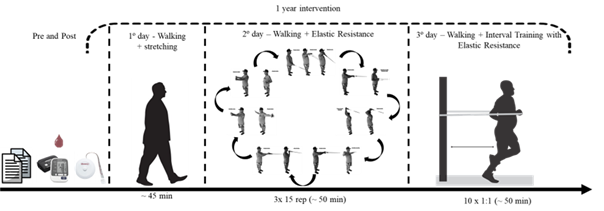
Source: Author
Figure 1 - Research design
Data analysis
and statistical procedures
After
verifying normality using the Shapiro–Wilk test (GraphPad Prism v.9.3.0),
paired t-tests were applied to compare means. The typical error (TE) of the
anthropometric variables was calculated using the formula: SD/√n, where
SD is the standard deviation and n is the sample size. Effect size (ES- Cohen’s
d) was determined and classified according to the following arbitrary scale:
null (0–0.19), small (0.20–0.49), moderate (0.50–0.79), and large (≥ 0.80).
An alpha error < 5% was adopted.
Results
Table I - Anthropometric, hemodynamic, and metabolic data before and after 1 year of supervised physical training (n = 8)
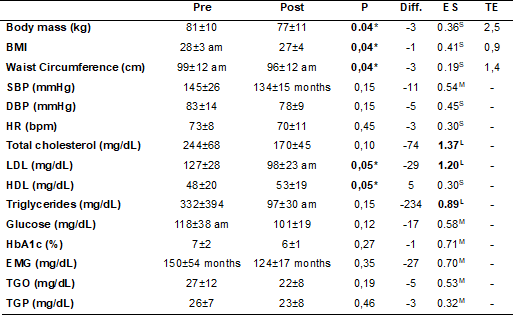
Body Mass Index (BMI), Systolic Blood Pressure (SBP),
Diastolic Blood Pressure (DBP), Heart Rate (HR), Low-Density Lipoprotein (LDL),
High-Density Lipoprotein (HDL), Glycated Hemoglobin (HbA1C), Estimated Mean
Blood Glucose (EMG), Glutamic-Oxaloacetic Transaminase (TGO), Glutamic-Pyruvic
Transaminase (TGP). * (P ≤ 0.05); Diff. (Post-Pre
Difference); ES (Effect Size). N, S, M, L – Effects: null,
small, moderate and large; TE (Typical Error)
Discussion
Our main findings indicate that one year of supervised
physical exercise produced clinically meaningful improvements in hemodynamic
and metabolic variables among male participants of PROEF, with effect sizes
ranging from small to large. These results align with the findings of Ambrosim et al. [10], who reported that participants
in a public exercise guidance program presented lower and normalized levels of
total cholesterol, HDL, LDL, triglycerides, and blood glucose compared with non-participants.
In our study, LDL levels decreased and HDL levels increased, while total
cholesterol demonstrated a large-effect reduction, reaching normal ranges.
Furthermore, normalization of LDL and HDL values suggests a reduced risk of
mortality from cardiovascular diseases.
The risk of mortality can rise by up to 68% in
patients with severe hypertriglyceridemia (> 500 mg/dL)
Despite these promising outcomes, several limitations
must be acknowledged. The sample was selected for convenience from physical
evaluations and reevaluations conducted between 2023 and 2024 at a single PROEF
site, with all data collected by the same evaluator at the Serra Dourada III Community Center, Serra/ES - a venue provided
in partnership with the local government for physical activity programs.
Although this context lends potential ecological validity, the absence of a
priori sample size calculation, the convenience sampling approach, and the lack
of a control group may have influenced the results. Nonetheless, the findings
provide valuable insights into cardiometabolic parameters and associated risk
factors, supporting the potential effectiveness of PROEF in improving the
physical and metabolic health of middle-aged and older men.
These results can serve as a basis for future
interventions with more robust experimental designs, such as longitudinal
randomized clinical trials, ideally conducted in partnership with federal and
state public higher education institutions—particularly in the fields of
Physical Education and Public Health. Such initiatives could facilitate the
expansion of physical activity and exercise programs for the general
population, with special emphasis on men’s health.
Conclusion
One year of supervised physical exercise within the
PROEF program produced clinically relevant improvements in hemodynamic and
metabolic parameters among middle-aged and older men.
Acknowledgments
The authors thank PROEF/PMS for enabling the
development of this study and extend their gratitude to all participants for
their commitment and collaboration.
Conflicts of interest
The authors declare no conflicts of interest.
Funding
This research has no funding.
Author contributions
Conception
and design of the research: Gasparine Neto VH,
Carletti L; Data collection: Gasparine
Neto VH, Santos Junior CR; Analysis and
interpretation of data: Gasparine Neto VH, Alves SP, Nunes LB, Neves LNS,
Duarte LF, Leite RD, Carletti L; Statistical
analysis: Gasparine Neto VH, Carletti L, Neves LNS; Writing of the manuscript; Gasparine Neto VH, Santos Junior CR,
Alves SP, Nunes LB, Duarte LF, Leite RD,
Carletti L; Critical review of the
manuscript for important intellectual content: Santos Junior CR, Leite RD,
Carletti L
References
- Strain T,
Flaxman S, Guthold R, Semenova E, Cowan M, Riley LM,
et al. National, regional, and global trends in insufficient physical activity
among adults from 2000 to 2022: a pooled analysis of 507 population-based
surveys with 5·7 million participants. Lancet Glob Health. 2024;12(8):e1232–43. https://doi.org/10.1016/S2214-109X(24)00150-5 [Crossref]
- Thandi MKG, Phinney A, Oliffe JL, Wong S, McKay H, Sims-Gould J, et al. Engaging older men in physical activity: implications for health promotion practice. Am J Mens Health. 2018;12(6):2064–75. doi: 10.1177/1557988318792158 [Crossref]
- Ivanova E, Sadikaj G, Bourne JE, Beauchamp M, Little JP, Jung ME. A
pilot study on in-task affect predicting free-living adherence to HIIT and
MICT. Res Q Exerc Sport. 2022;93(2):291–300. doi: 10.1080/02701367.2020.1828562 [Crossref]
- Timmons JF, Minnock D, Hone M, Cogan KE, Murphy JC, Egan B. Comparison of time-matched aerobic, resistance, or concurrent exercise training in older adults. Scand J Med Sci Sports. 2018;28(11). doi: 10.1111/sms.13254 [Crossref]
- Lima FF,
Camillo CA, Gobbo LA, Trevisan IB, Nascimento WBBM, Silva BSA, et al.
Resistance training using low cost elastic tubing is
equally effective to conventional weight machines in middle-aged to older
healthy adults: A quasi-randomized controlled clinical trial. J Sports Sci Med.
2018;17(1):153–60. PMID: 29535589
- Gasparini-Neto VH, Caldas LC, Lira CAB, Carletti L, Leite RD, Nikolaidis PT, et al. Profile of blood pressure and glycemic responses after interval exercise in older women attending (in) a public health physical activity program. J Bodyw Mov Ther 2021;25:119–25. doi: 10.1016/j.jbmt.2020.10.011 [Crossref]
- Panzarino M, Gravina A, Carosi V, Crobeddu P, Tiroli A, Lombardi R, et al. Cardiovascular and hemodynamic responses to adapted physical exercises in very old adults. Aging Clin Exp Res. 2017;29(3):419–26. doi: 10.1007/s40520-016-0598-2 [Crossref]
- Vion J, Sramkova V, Montastier E, Marquès MA, Caspar-Bauguil S, Duparc T, et al. Metabolic and cardiovascular adaptations to an 8-wk lifestyle weight loss intervention in younger and older obese men. Am J Physiol Endocrinol Metab. 2021;321(3):E325–37. doi: 10.1152/ajpendo.00109.2021 [Crossref]
- Feitosa ADM, Barroso WKS, Mion Junior D, Nobre F, Mota-Gomes MA, Jardim PCBV, et al. Diretrizes Brasileiras de Medidas da Pressão Arterial Dentro e Fora do Consultório – 2023. Arq Bras Cardiol. 2024;121(4):1–48. doi: 10.36660/abc.20240113 [Crossref]
- Ambrosim MF, Gasparini-Neto VH, Umpierre D, Leopoldo AS, Carletti L, Mill JG. Health profile of individuals participating in a public exercise program. Sci Sports. 2023;38(7):734.e1-734.e9. doi: 10.1016/j.scispo.2022.04.006 [Crossref]
- Klempfner R, Erez A, Sagit BZ, Goldenberg I, Fisman E, Kopel E, et al. Elevated triglyceride level is independently associated with increased all-cause mortality in patients with established coronary heart disease: twenty-two-year follow-up of the bezafibrate infarction prevention study and registry. Circ Cardiovasc Qual Outcomes. 2016;9(2). doi: 10.1161/CIRCOUTCOMES.115.002104 [Crossref]
- Khan NA,
Hemmelgarn B, Herman RJ, Bell CM, Mahon JL, Leiter LA, et al. The 2009 Canadian
Hypertension Education Program recommendations for the management of
hypertension: Part 2--therapy. Can J Cardiol. 2009. doi: 10.1016/s0828-282x(09)70492-1 [Crossref]
- Li L, Liu X,
Shen F, Xu N, Li Y, Xu K, et al. Effects of high-intensity interval training
versus moderate-intensity continuous training on blood pressure in patients
with hypertension: A meta-analysis. Medicine. 2022;101(50). doi: 10.1097/MD.0000000000032246 [Crossref]
- Touyz RM, Campbell N, Logan a, Gledhill N, Petrella R, Padwal R. The 2004 Canadian recommendations for the management of hypertension: Part III-Lifestyle modifications to prevent and control hypertension. Can J Cardiol. 2004. PMID: 14968143
