Rev Bras Fisiol Exerc. 2026;25(1):e255650
doi: 10.33233/rbfex.v25i2.5650
ORIGINAL ARTICLE
Is there a correlation between age and heart rate recovery in amateur
runners after the Cooper test?
Existe correlação
entre idade e recuperação da frequência cardíaca em corredores amadores após
Teste de Cooper?
Wellington Isaac Soares1,
Vitor Alves Marques1, Naiany Pereira Silva2,
Franassis Barbosa de Oliveira1, Fábio
Santana1
1Universidade Estadual de Goiás,
Quirinópolis, Goiás, Brazil
2Universidade Federal de Goiás, Goiânia,
Goiás, Brazil
Received: November 26,
2025; Accepted: March 2,
2026
Correspondence: Naiany
Pereira Silva, naianypereira156@gmail.com
How to
cite
Soares WI, Marques
VA, Silva NP, Oliveira FB, Santana F. Is there a correlation between age and heart rate recovery in amateur runners after the Cooper test? Rev Bras
Fisiol Exerc
2026;25(2):e255650. doi: 10.33233/rbfex.v25i2.5650
Abstract
Introduction: Heart rate (HR) recovery
after exercise is widely used
as an indicator of autonomic modulation
and aerobic fitness. However,
the influence of age on this process remains unclear in amateur runners. Objective:
This study aimed to analyze the correlation between age and HR during recovery
at different moments after the Cooper Test. Method :Twenty-two male
amateur runners, aged 20 to 39 years, were evaluated. HR was measured at rest
(F0), immediately post-test (F1), and five minutes post-exercise (F2). Data
normality was verified using the Shapiro–Wilk test, and Spearman’s correlation
coefficient was applied to assess the relationship between age and HR. Results:
A strong and statistically significant negative correlation was found between
age and HR at F1 (r = -0.997; p < 0.001) and F2 (r = -0.991; p < 0.001),
indicating that older individuals exhibited lower HR values post-exercise. Conclusion:
These findings suggest that age influences the chronotropic response to
exercise, with older individuals reaching lower peak HR values and subsequently
presenting lower HR values during early recovery. This pattern does not
necessarily reflect faster recovery but may be associated with reduced
sympathetic activation during exertion. Future studies should incorporate
direct measurements of autonomic modulation and aerobic fitness to provide a
deeper understanding of this relationship.
Keywords: heart rate; autonomic nervous system; age
Resumo
Introdução: A recuperação da frequência cardíaca
(FC) após o exercício é amplamente utilizada como indicador da modulação
autonômica e da aptidão aeróbia. No entanto, a influência da idade nesse
processo em corredores amadores ainda não está totalmente esclarecida. Objetivo:
Analisar a correlação entre idade e FC durante a recuperação em diferentes
momentos após o Teste de Cooper. Participaram 22 corredores amadores do sexo
masculino, com idades entre 20 e 39 anos. Método: A FC foi registrada em
repouso (F0), imediatamente após o teste (F1) e cinco minutos após o esforço
(F2). A normalidade dos dados foi verificada pelo teste de Shapiro-Wilk, e a
correlação entre idade e FC foi avaliada pelo coeficiente de Spearman. Resultados: Observou-se correlação
negativa forte e significativa entre idade e FC em F1 (r = -0,997; p <
0,001) e F2 (r = -0,991; p < 0,001), indicando que indivíduos mais velhos
apresentaram valores menores de FC pós-esforço. Conclusão: Esses achados
sugerem que a idade influencia a resposta cronotrópica ao esforço, com
indivíduos mais velhos atingindo menores picos de FC e, consequentemente,
exibindo valores mais baixos durante a recuperação inicial. Isso não implica
necessariamente em recuperação mais rápida, mas pode refletir menor ativação
simpática durante o exercício. Estudos futuros devem incorporar medidas diretas
da modulação autonômica e da aptidão aeróbia para aprofundar a compreensão
dessa relação.
Palavras-chave: frequência cardíaca; sistema nervoso
autônomo; idade
Introduction
Heart rate recovery after intense exercise has been
widely used as an indicator of cardiac autonomic modulation and aerobic
fitness. Heart rate is a fundamental physiological variable for training
prescription and for monitoring exercise load in both amateur and professional
athletes [1]. The ability of heart rate to recover reflects the efficiency of
sympathetic withdrawal and parasympathetic reactivation at the end of exercise,
and it may be associated with lower cardiovascular risk and improved athletic performance
[2]. However, the influence of age on this process is not yet fully understood,
particularly among amateur road runners.
Studies suggest that the heart rate response to exercise
and its recovery are modulated by autonomic adjustments, in which the
withdrawal of sympathetic activation and the restoration of parasympathetic
tone occur at different stages of recovery [3]. Nevertheless, this relationship
may vary according to age. Some studies indicate that younger individuals tend
to reach higher heart rate values during maximal exertion and exhibit a more
pronounced deceleration during the early phase of recovery, whereas older
individuals may show smaller initial changes in HR during this period [4].
However, the mechanisms underlying these differences remain under debate and
may involve factors such as aerobic fitness, training load, and individual
characteristics of the autonomic nervous system.
Therefore, the present study aimed to analyze the
correlation between age and heart rate recovery after the Cooper Test in
amateur runners. The central hypothesis was that there is a negative
relationship between age and HR immediately after the test, suggesting that
older individuals tend to have lower absolute post-exercise HR values. However,
this relationship does not necessarily imply faster recovery, as it may be
associated with factors such as lower sympathetic activation during exercise
and lower peak HR achieved. The findings of this study may contribute to
improving individualized training prescription strategies, assisting in
intensity control and optimizing post-exercise recovery across different age
groups.
Methods
This is a cross-sectional study conducted and reported in
accordance with the Strengthening the Reporting of Observational Studies in
Epidemiology (STROBE) guidelines. The study was approved by the Ethics
Committee of the State University of Goiás (Resolution 466/12). All volunteers
were informed about the procedures to which they would be subjected and signed
an informed consent form.
Participants
Male amateur runners aged between 20 and 45 years who had
been regularly practicing road running for at least six months were included in
the study. Participants were recruited voluntarily through convenience sampling
and were informed about the study procedures prior to signing the informed
consent form. To ensure sample homogeneity, specific inclusion criteria were
established. Only individuals affiliated with a private higher education
institution in the city of Anápolis, Goiás, Brazil, and duly registered with
the Brazilian Athletics Confederation (CBAt), were eligible to participate. In
addition, only healthy athletes with no history of cardiovascular, metabolic,
or neuromuscular diseases that could compromise the physiological response to
the test were included. Individuals with recent musculoskeletal injuries, using
medications known to affect the autonomic modulation of heart rate, or who did
not complete all stages of the evaluation protocol, were excluded.
Variables
Physiological and anthropometric variables were analyzed
to investigate the correlation between age and heart rate behavior at different
post-exercise time points. The primary variable was heart rate, measured at
three distinct time points: at rest (F0), immediately after the Cooper Test
(F1), and five minutes after exertion (F2). In addition, sociodemographic and
anthropometric variables were collected, including age, body weight (in
kilograms), height (in meters), and body mass index (BMI), calculated using the
equation weight/height². The cardiovascular response during the test was
monitored using a digital heart rate monitor, ensuring continuous and accurate
recording of heart rate variations.
Procedures
The evaluation procedures were conducted in a controlled
environment to ensure standardized conditions for data collection. Participants
were instructed to refrain from consuming alcoholic beverages, caffeine, and/or
other stimulating substances, as well as to avoid strenuous exercise during the
24 hours before the test. They
were also advised to consume a light meal at least
two hours prior to the assessment. On the testing days, participants were
required to wear comfortable clothing and suitable running shoes. Before data
collection, they were asked about their general health status and sleep quality
on the previous night to ensure that they were fit to participate in the
procedures.
Test protocols
Aerobic exercise test
Participants underwent the Cooper Test, a protocol widely
used to assess aerobic capacity, consisting of a continuous maximal-intensity
run for 12 minutes on an official athletics track [5]. The purpose of the test
was to evaluate the heart rate response to exercise and cardiovascular recovery
at different post-exercise time points. During the test, heart rate was
continuously monitored using a Garmin Forerunner 920XT digital heart rate
monitor, ensuring accurate recordings of heart rate variation throughout the
test. Blood pressure was measured before and after the test using a digital
sphygmomanometer (Omron HEM-7130), and peripheral oxygen saturation (SpO2)
was assessed using a portable pulse oximeter (Yonker YK-81A) to monitor blood
oxygenation during recovery.
Maximum heart rate was estimated using the equation HRmax
= 208 - (0.7 × age) [6], which was used as a reference to analyze the level of
exertion reached by the participants. Heart rate data were collected at three
distinct time points: at rest (F0), prior to the beginning of the test, with
participants seated for at least five minutes; post-test (F1), immediately
after the completion of the run, recording the maximum heart rate achieved; and
five minutes after exertion (F2), assessing the initial phase of heart rate
recovery.
All tests were conducted at the same time of day to
minimize the effects of circadian variations. A rigorous standardization
protocol was followed to ensure data reliability. Criteria for test
interruption included signs of physical exhaustion, complaints of dizziness,
discomfort, or any physiological alteration that could compromise participant
safety.
Statistical analysis
Statistical analysis was performed using Jamovi®
software, version 0.7.2.6. Initially, descriptive statistics were conducted,
including the calculation of mean, standard deviation, minimum and maximum
values for the variables age, body mass, height, body mass index (BMI), and
heart rate (HR) at the different time points evaluated. Additionally, the
variation (D) between resting
HR (F0) and post-test HR (F1), as well as the variation (D) between F1 and five minutes after exertion (F2), were
quantified (final HR – initial HR). Percentage differences were also calculated
between F0 and F1 and between F1 and F2. Data normality was assessed using the
Shapiro–Wilk test. The results indicated that resting HR (F0) followed a normal
distribution (p ≥ 0.05), whereas post-test HR (F1) and HR five minutes
after exertion (F2) did not follow a normal distribution (p < 0.05),
justifying the selection of appropriate statistical tests for each analysis.
To evaluate the relationship between age and heart rate
recovery at the different time points following the Cooper Test, Spearman’s
correlation coefficients were calculated. This test allowed determination of
the strength and direction of the correlation between age and HR during phases
F1 and F2. The interpretation followed the criteria proposed by Dancey and
Reidy [7], in which values close to ±1 indicate a strong correlation, values
between ±0.30 and ±0.70 indicate a moderate correlation, and values below ±0.30
indicate a weak correlation.
Results
Anthropometric characteristics
A total of 22 male amateur runners were evaluated. The
mean age of the participants was 26.3 ± 5.3 years, ranging from 20 to 39 years.
The mean body mass was 73.3 ± 8.6 kg, with values ranging from 60 to 89 kg. The
mean height recorded was 172 ± 6.0 cm, ranging from 158 to 183 cm. The mean
body mass index (BMI) was 24.9 ± 2.5 kg/m², with a minimum of 20.0 kg/m² and a
maximum of 26.5 kg/m². Table I presents the characteristics of the sample,
including measures of central tendency and dispersion (n = 22).
Table I – Characterization of the participants (n = 22)
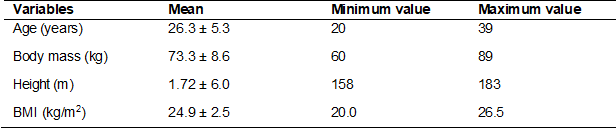
BMI = Body Mass Index. Continuous variables are expressed
as mean and standard deviation (SD)
The results obtained from the analysis of heart rate at
different moments of the Cooper Test revealed variations between the resting
and recovery phases. The resting heart rate (F0) had a mean value of 70.3 ±
10.2 bpm, which reflects the participants’ baseline state before the test.
After the Cooper Test, a marked increase in heart rate was observed immediately
post-exercise (F1), reaching a mean of 181.0 ± 3.5 bpm, a value close to the
estimated maximum heart rate for the sample (≈190 bpm),
calculated based on the equation proposed by Tanaka et al. [6]. The
variation (D) between the means
was 110.7 bpm, representing an average increase of 147.46%. This increase was
expected, as it reflects the cardiovascular response to high-intensity
exercise. However, after five minutes of recovery (F2), heart rate showed a
significant mean reduction to 150.0 ± 3.0 bpm (a variation of 31 bpm or
17.12%), indicating the onset of parasympathetic reactivation and the
progressive autonomic recovery following exertion. Table II presents the
central and dispersion values of heart rate at the different time points of the
test, including minimum and maximum values and the variations between the
different phases of the protocol.
Table II – Mean (SD) heart rate and variations (D) at different time points after the Cooper Test (n = 22)
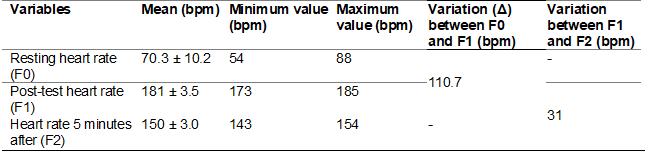
HR = Heart rate. Continuous variables are expressed as
mean and standard deviation (SD)
The analysis of the correlation between age and heart
rate at different time points of the Cooper Test revealed a significant
relationship between these variables. Table III presents the Spearman
correlation coefficients (r) and the corresponding statistical significance
values (p) for the analyzed moments: resting (F0), immediately after the test
(F1), and five minutes after exertion (F2). A strong and statistically
significant negative correlation was observed between age and heart rate
immediately after the test (F1, r = -0.997; p < 0.001) and between age and
heart rate five minutes after exertion (F2, r = -0.991; p < 0.001). These
findings indicate that as age increases, heart rate values at the post-test
moments tend to be lower, suggesting an inverse relationship between age and
heart rate during the initial recovery phase. In addition, a weak negative
correlation was observed between age and resting heart rate, without
statistical significance (F0, r = -0.026; p = 0.910), indicating that age did
not exert a relevant influence on the participants’ baseline heart rate.
Table III – Correlation between age and heart rate at different
time points after the Cooper Test (n = 22)

*Statistically significant. HR = Heart rate
Discussion
The present study aimed to analyze the correlation
between age and heart rate recovery at different time points following the
Cooper Test in amateur runners. Our initial hypothesis suggested that age would
significantly influence the heart rate response after exertion, with younger
athletes showing a greater initial variation in heart rate and older athletes
demonstrating an apparently faster recovery, possibly due to lower peak heart
rate values during maximal effort. The findings of the study indicated that
there is a negative correlation between age and heart rate immediately after
the test (F1). This suggests that, as age increases, post-exercise heart rate
tends to be lower.
This result may be related to individual differences in
the cardiovascular response to exercise; however, it does not allow us to
conclude that age alone is responsible for this variation, since factors such
as physical fitness and individual physiological characteristics may also
influence this relationship. In this context, the high correlation coefficients
may suggest a structural dependency between age and HR, possibly amplified by
the physiological decline in maximal heart rate with aging, rather than necessarily
reflecting a genuine physiological relationship with autonomic recovery.
Previous studies have shown that heart rate recovery is
modulated by the autonomic balance between the sympathetic and parasympathetic
systems. This process is more efficient in individuals with higher aerobic
fitness and lower residual sympathetic activation after exercise [8]. However,
while the literature often suggests that younger individuals tend to recover
heart rate more rapidly due to greater heart rate variability and more
efficient vagal reactivation [9], our findings show that older runners had lower
heart rate values immediately after the test. This relationship does not allow
us to conclude directly that older individuals exhibit faster heart rate
recovery, but it does suggest that the chronotropic response to exercise may be
lower with increasing age, which could influence the perception of immediate
recovery [10].
A possible explanation for this phenomenon is that the
chronotropic response to exercise decreases with age, leading to a reduction in
the maximum heart rate achieved during exertion [10]. This factor may create
the false impression that older individuals recover heart rate more quickly,
when in fact the lower magnitude of the initial sympathetic response makes
heart rate deceleration appear more efficient [11]. However, this hypothesis
would require further investigation using direct measurements of autonomic
activity, such as heart rate variability (HRV), in order to confirm whether
differences exist in sympathetic and parasympathetic activation across
different age groups.
Among the limitations of this study, the small sample
size and the lack of control for factors such as participants’ level of aerobic
fitness should be highlighted, which may overestimate the observed associations
and reduce external reliability. Although all participants were amateur runners
officially registered with the athletics federation, differences in training
volume and intensity may influence heart rate recovery, since individuals with
higher aerobic fitness tend to exhibit more efficient recovery [11]. In
addition, because the study relied solely on correlation analysis, it was not
possible to evaluate the influence of other potentially relevant variables,
such as training load and years of sports practice, which could independently
affect heart rate recovery regardless of age. Furthermore, the analysis of
heart rate recovery was based on absolute HR values and their absolute and
percentage variations at different time points of the Cooper Test, rather than
using metrics such as Heart Rate Recovery (HRR), defined as the decrease in HR
during the first minute after exercise, which should exceed 12 bpm.
Based on these results, future studies should further
investigate the interaction between age, aerobic fitness, and autonomic
activation during exercise and recovery. Understanding these relationships may
contribute to the development of more effective training prescription
strategies, assisting in the control of exercise intensity and in optimizing
post-exercise recovery for different athlete profiles [12]. In addition, future
research may consider including direct measurements of autonomic activation (e.g.,
heart rate variability) and aerobic fitness (e.g., VO2max) in order
to more accurately differentiate the effects of age and fitness level on heart
rate recovery.
Conclusion
The findings of this study indicated a negative
correlation between age and heart rate immediately after the Cooper Test,
suggesting that older individuals tend to have lower post-exercise HR values.
However, this relationship does not necessarily imply faster HR recovery, as
the lower post-test HR may be associated with reduced sympathetic activation
and a lower maximal heart rate achieved during exertion.
Conflict of Interest
The authors declare that there are no financial,
commercial, personal, or political conflicts of interest related to the subject
and development of this article.
Funding
This study did not receive financial support from public,
private, or third-sector funding agencies.
Author contributions
Study conception and design:
Soares WI, Santana F; Data collection: Soares WI; Data analysis and
interpretation: Soares WI, Marques VA, Silva NP, Oliveira FB; Statistical
analysis: Soares WI, Santana F; Funding acquisition: not applicable;
Manuscript writing: Santana F, Marques VA, Silva NP, Oliveira FB; Critical
revision of the manuscript for important intellectual content: Santana F,
Marques VA, Silva NP, Oliveira FB.
References
- Borresen J, Lambert MI. Autonomic control of heart rate during and after
exercise: measurements and implications for monitoring training status. Sports
Med. 2009;39(9):813-29.doi: 10.2165/00007256-200838080-00002 [Crossref]
- Pepera G, Panagiota P. Heart rate recovery after exercise: an overview. Eur J Sport Sci. 2021;21(5):685-95.doi: 10.3390/ijerph20064678 [Crossref]
- Azevedo LF, Perlingeiro PSM, Brum PC. Respostas autonômicas cardiovasculares ao exercício físico e sua recuperação: uma revisão de literatura. Rev Bras Med Esporte. 2007;13(2):83-8.doi: 10.3389/fphys.2017.00301 [Crossref]
- Fleg JL, O’Connor F, Gerstenblith G, Becker LC, Clulow J, Schulman SP, et al. Impact of age on the cardiovascular response to dynamic upright exercise in healthy men and women. J Appl Physiol. 1995;78(3):890-900.doi: 10.1152/jappl.1995.78.3.890 [Crossref]
- Cooper KH. A means of assessing maximal oxygen intake: correlation between
field and treadmill testing. JAMA. 1968;203(3):201-4. PMID: 5694044
- Tanaka H, Monahan KD, Seals DR. Age-predicted maximal heart rate revisited. J Am Coll Cardiol. 2001;37(1):153-6.doi: 10.1016/s0735-1097(00)01054-8 [Crossref]
- Dancey C, Reidy J. Statistics without maths for psychology. 4th ed. Harlow:
Pearson Education; 2006.
- Perini R, Veicsteinas A. Heart rate variability and autonomic activity at rest and during exercise in various physiological conditions. Eur J Appl Physiol. 2003;90:317-25.doi: 10.1007/s00421-003-0953-9 [Crossref]
- Yoshio H, Shimizu M, Sugihara N, Kita Y, Shimizu K, Minagawa F. Assessment of autonomic nervous activity by heart rate spectral analysis in patients with variant angina. Am Heart J. 1993;125(2):324-9.doi: 10.1016/0002-8703(93)90007-v [Crossref]
- Seals DR, Chase PB. Influence of physical training on heart rate variability and baroreflex function in older individuals. Am J Physiol Regul Integr Comp Physiol. 1989;265(3):R755-60.doi: 10.1152/jappl.1989.66.4.1886 [Crossref]
- Imai K, Sato M, Hagiwara N, Ozaki M, Ito H, Takeda H. Vagally mediated heart rate recovery after exercise is accelerated in endurance-trained athletes. Am J Cardiol. 1994;78(5):581-5.doi: 10.1249/01.mss.0000241647.13220.4c [Crossref]
- Billman GE. Aerobic exercise conditioning: a nonpharmacological antiarrhythmic intervention. J Appl Physiol. 2002;92(2):446-54.doi: 10.1152/japplphysiol.00874.2001 [Crossref]
